US LLC Tax Filing Non-Resident Guide: Avoid the $25,000 Form 5472 Penalty
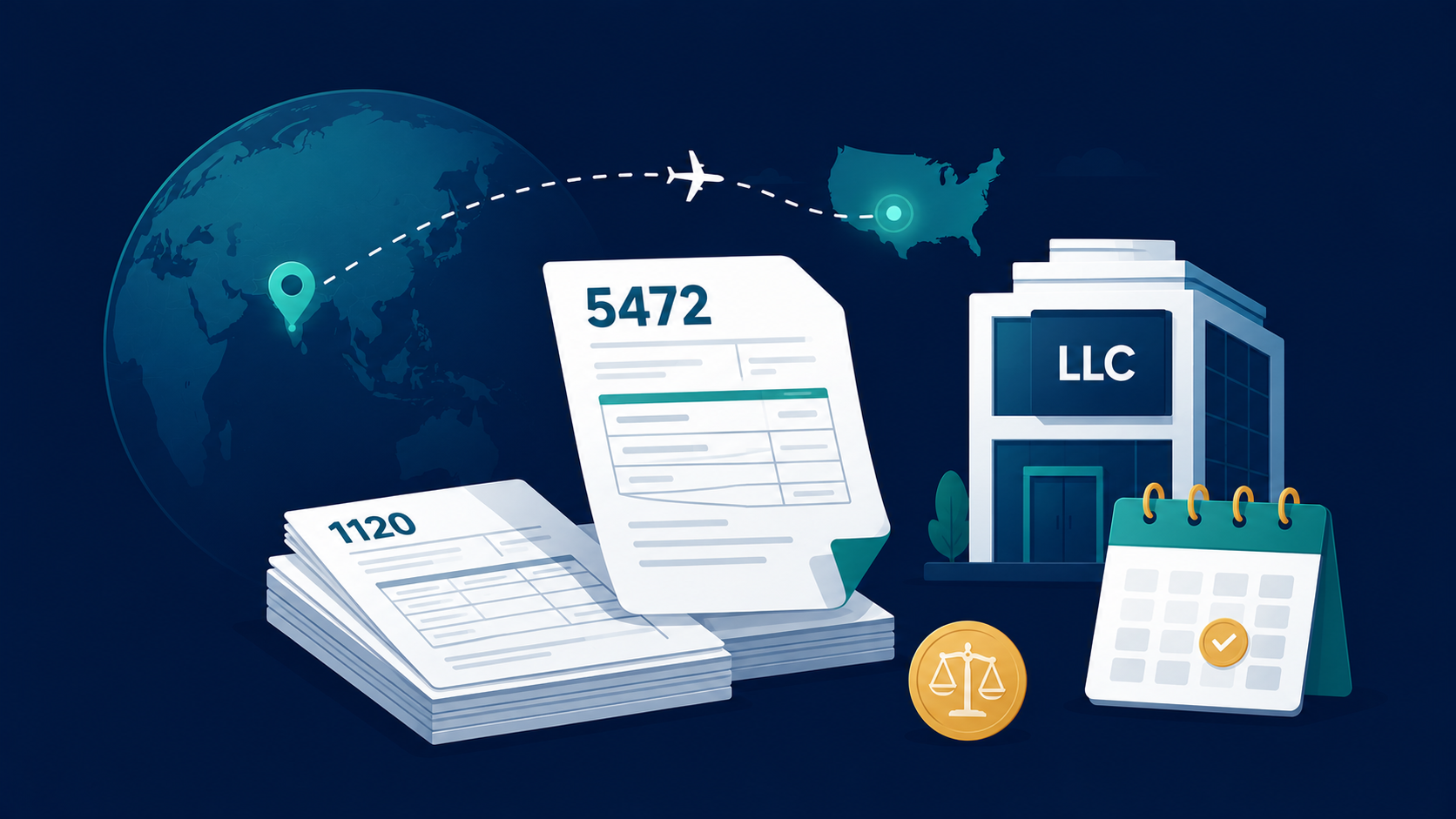
If you own a US LLC and you're not a US person, there is a form you almost certainly have to file — even if the company earned nothing, even if it never opened a bank account, even if it has sat dormant since the day it was registered. Miss it and the penalty starts at $25,000. Form 5472 is the piece of US LLC tax filing non-resident owners overlook more than any other, usually because of a reassuring bit of jargon: their LLC is a "disregarded entity." Disregarded for income tax does not mean invisible to the IRS.
Why "disregarded entity" is the most expensive phrase in US tax
When a single-member LLC is owned by one person, the IRS generally ignores the company as a separate taxpayer and treats its income as the owner's. That's what "disregarded" means, and for income tax purposes it's genuinely simplifying.
The trouble is what founders hear. They hear that the IRS doesn't see the company at all, conclude there's nothing to file, and go quiet for three years.
Information reporting works on a completely different logic from income tax. Since tax years beginning on or after 1 January 2017, a foreign-owned US disregarded entity — which includes the overwhelming majority of single-member LLCs owned by non-residents — has had its own filing obligation regardless of income, activity, or profitability. The company is disregarded for calculating tax. It is very much regarded for telling the IRS what happened.
Who has to file Form 5472?
Two groups, broadly:
A US corporation that is at least 25% foreign-owned and has had a reportable transaction with a related party during the year.
A foreign-owned US disregarded entity, including a single-member LLC owned by a non-resident, with any reportable transaction.
If you're a founder in Karachi, Dubai, Mumbai, or London holding a Wyoming or Delaware LLC on your own, you are almost certainly in the second group.
The threshold question people get wrong is what counts as a "reportable transaction." It is not limited to sales and revenue. Capital contributions count. Distributions count. Loans between you and the company count. Money you put in to open the bank account counts.
In practice, the act of funding your own LLC creates a reportable transaction. This is why a company with no customers and no income still has a filing obligation — the formation and funding themselves are reportable.
US LLC tax filing non-resident deadlines: when Form 5472 is due
Form 5472 does not travel alone. A foreign-owned disregarded entity files it attached to a pro forma Form 1120 — a stripped-back corporate return that exists purely as a carrier for the information return. You write "Foreign-owned U.S. DE" across the top.
For a calendar-year LLC, the deadline is 15 April following the end of the tax year. So the 2025 tax year is due 15 April 2026.
You can get an automatic six-month extension to 15 October by filing Form 7004 — but only if you file it by the original due date. An extension requested after 15 April does nothing.
Two procedural traps worth knowing before you start:
You generally cannot e-file in this situation. The pro forma 1120 with Form 5472 goes by mail or fax to a specific IRS address, not the standard corporate filing address.
An extension of the filing deadline is not an extension of your record-keeping duty. You're expected to have maintained the underlying records all along.
The penalty — and why it compounds
Under IRC §6038A(d)(1), the IRS imposes a $25,000 penalty per Form 5472, per tax year for failing to file, filing late, filing a substantially incomplete form, or failing to maintain the required records.
Three features make this worse than the headline number suggests.
It multiplies by related party. A separate Form 5472 is required for each related party you transacted with. Two related parties, two forms, and a late filing can mean $50,000 rather than $25,000.
It compounds after notice. If the IRS notifies you and the failure continues beyond 90 days, an additional $25,000 accrues for each subsequent 30-day period. There is no stated maximum. A single missed year, left unresolved for several months after an IRS notice, can climb into six figures.
It doesn't expire. Failing to file an information return can leave the statute of limitations open on the entire return indefinitely. A missed 2019 filing doesn't quietly age out.
Reasonable-cause relief exists and is sometimes granted, but it has to be argued properly, and it's far easier to file late voluntarily than to respond to a notice. If you've missed years, the sensible move is to get advice and come forward deliberately rather than hope.
What else you may owe
Form 5472 is the one that catches people, but it's rarely the whole picture. Depending on your situation you may also face:
Form 1040-NR, your personal non-resident return, if you have income effectively connected with a US trade or business or other US-source income requiring a return.
State obligations — annual reports and franchise taxes in your state of formation. Wyoming and Delaware have their own deadlines and fees entirely separate from anything federal.
Employment and information returns if you have US contractors or staff.
The point of getting US LLC tax filing non-resident compliance right in one pass is that these obligations interlock. Filing the 5472 while ignoring a state annual report simply moves the problem.
Do you also need an ITIN?
Frequently, yes — and the two get confused. Your EIN identifies the company. An ITIN identifies you personally, and you'll need one if you reach the point of filing a 1040-NR or a payer requires a tax number in your own name.
The practical warning is timing. ITIN processing runs several weeks at best and considerably longer during tax season, so discovering in March that you need one to file in April is a bad position. As an IRS Certified Acceptance Agent, Accountaxpert verifies your identity documents in-house — your original passport never leaves your hands. Our complete ITIN guide for non-residents walks through the application in full.
What good compliance actually looks like
None of this is difficult when it's handled on a schedule rather than in a panic. A workable annual rhythm looks like this:
Keep clean books through the year, recording every transfer between you and the company — those are your reportable transactions.
Confirm your entity classification and who your related parties are before year-end, not after.
File the pro forma 1120 and Form 5472 by 15 April, or file Form 7004 by 15 April to move to October.
Handle your state annual report and franchise tax on their own separate deadlines.
Review whether a personal 1040-NR is required, and whether you need an ITIN to file it.
If your books are the weak link, that's the piece to fix first — the filings are only as good as the records behind them, and reconstructing a year of transactions in April is where costs escalate. Our company setup and compliance services cover the formation side if you're still structuring.
Frequently asked questions
Do I have to file Form 5472 if my LLC had no income?
Yes, in almost all cases. The filing requirement is triggered by reportable transactions with related parties, not by profit. Funding the company, paying formation costs from your own pocket, or taking money out all count as reportable transactions — and a company that has been formed and funded has therefore had them. A dormant LLC with zero customers and zero revenue still generally has to file a pro forma Form 1120 with Form 5472 attached. Assuming that no income means no filing is the single most common and most expensive mistake in this area.
What counts as a reportable transaction?
Far more than sales. It includes capital contributions from you to the LLC, distributions from the LLC to you, loans in either direction, payments for services, rent, royalties, interest, and transfers of property. For a typical non-resident-owned single-member LLC, the money used to fund the company and any money drawn out are the transactions that matter most. Non-monetary transactions count too and are frequently omitted, which can make a filed form "substantially incomplete" — which carries the same penalty as not filing at all.
Can I e-file Form 5472 for my foreign-owned LLC?
Generally not in the disregarded-entity context. The pro forma Form 1120 with Form 5472 attached is submitted by mail or fax to a specific IRS address, and the standard corporate e-filing route doesn't apply. This trips up founders who expect the process to be online end to end. Because the submission is physical, allow posting time and keep proof of the date you sent it — that evidence matters if the IRS later queries whether you filed on time.
What happens if I've never filed Form 5472?
The exposure is $25,000 per form, per year, and it can compound by an additional $25,000 for each 30-day period once a failure continues more than 90 days after IRS notice. Failing to file can also keep the statute of limitations open on the return indefinitely. That said, this is fixable, and coming forward voluntarily puts you in a considerably better position than waiting for a notice. Reasonable-cause relief is available in some circumstances but needs to be argued on the facts — get proper advice before filing several back years at once.
Is Form 5472 the same as paying US tax?
No. Form 5472 is an information return. It reports transactions between your LLC and its related parties; it does not itself calculate or create a tax liability. Plenty of non-resident LLC owners file it every year and owe nothing. That's exactly why it gets skipped — there's no bill attached to make it feel urgent. The penalty for skipping it, however, is real and is assessed regardless of whether any tax was owed.
Get your US LLC filings handled properly
Getting US LLC tax filing non-resident obligations right is mostly a question of doing unglamorous things on time. Accountaxpert handles Form 5472 and the pro forma 1120, your state annual reports and franchise tax, 1040-NR where required, and the monthly bookkeeping that makes all of it straightforward — for founders in 12+ countries running US companies from home.
This guide reflects US federal tax rules as of 2026 and is general information, not advice for your specific situation. Thresholds, deadlines, and penalty amounts change — verify current rules at IRS.gov or speak to our team before filing.