The Complete Guide to Getting a US ITIN as a Non-Resident
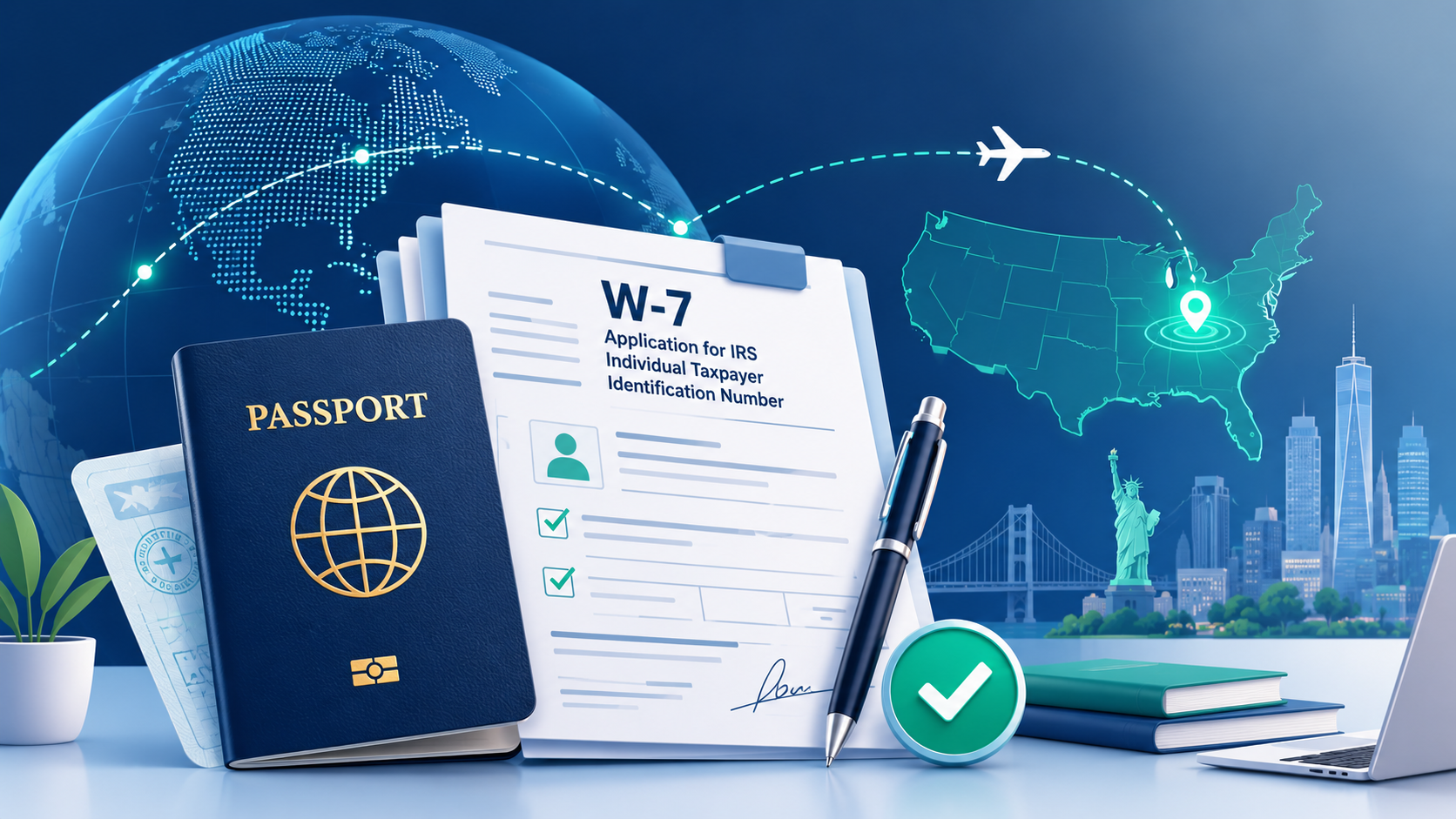
If you own a US company, earn US income, or need to file a US tax return but you're not eligible for a Social Security Number, there's one number standing between you and compliance: an ITIN. An ITIN for non-resident business owners is the tax processing number that lets you file, claim treaty benefits, and stay compliant with the IRS — from anywhere in the world. Most of the founders we work with didn't know this number existed until a bank, a marketplace, or the IRS asked for it, and that's completely normal. This guide walks you through exactly what an ITIN is, whether you need one, and how to get it without mailing your passport to the IRS.
What is an ITIN?
An ITIN — Individual Taxpayer Identification Number — is a nine-digit number the IRS issues to people who need to file or be listed on a US tax return but can't get a Social Security Number. It always starts with the digit 9.
Here's the key thing to understand: an ITIN is strictly a tax processing number. It does not give you the right to work in the US, it does not grant any immigration status, and it does not qualify you for Social Security benefits. It exists for one purpose — so the IRS can identify you on a tax filing.
That narrow purpose is also why so many non-residents need one. If the US tax system needs to see your name on a return, you need a number to put next to it.
Do you actually need an ITIN for non-resident tax filing?
Not every non-resident needs an ITIN, and part of our job is telling you honestly when you don't. But you likely need an ITIN for non-resident purposes if any of these apply to you:
You're a non-resident owner of a US LLC or corporation and you have to file a US tax return
You earn US-sourced income — rental income, royalties, or income effectively connected to a US business
You need to claim a reduced withholding rate under a tax treaty
You're opening a US interest-bearing bank account that requires one
You're a spouse or dependent being listed on someone's US return
One common point of confusion: an ITIN is for individuals. Your US business doesn't get an ITIN — it gets an EIN (Employer Identification Number), which is the business equivalent. Many non-resident founders need both: an EIN for the company and an ITIN for themselves. If you're not sure which you need, our ITIN vs EIN guide breaks it down.
The document that trips everyone up: your passport
To get an ITIN, you have to prove two things — your identity and your foreign status. A valid, unexpired passport is the one document that satisfies both on its own. That's why almost every clean application leads with a passport.
But here's the problem. The IRS requires original documents or copies certified by the issuing agency. Photocopies and notarized copies are usually rejected. So if you apply on your own by mail, you are literally putting your original passport in an envelope and sending it to Texas — where it can sit for weeks or months during processing.
For a founder in Karachi, Dubai, Mumbai, or London who might need that passport to travel next month, that's a non-starter.
This is where being an IRS Certified Acceptance Agent changes everything. As an IRS Certified Acceptance Agent, Accountaxpert verifies your identity documents in-house — your original passport never leaves your hands. We check your originals, certify the copies for the IRS, and you keep your passport the entire time.
How the application actually works: Form W-7
The ITIN application is Form W-7, the official IRS form. Getting it right is mostly about three things: the reason code, the supporting return, and the documents.
Step 1 — Choose the correct reason code
The top of Form W-7 asks why you need an ITIN. This isn't a formality — the box you check determines whether you must attach a tax return and which documents you need. Most non-resident business owners filing a US return fall under reason code "b." A founder claiming only a treaty benefit without filing a return uses a different code under an exception. Choosing the wrong code is one of the most common reasons applications get rejected.
Step 2 — Attach your tax return (usually)
This is the rule people get backwards most often. As a general rule, Form W-7 must be submitted together with your completed US federal tax return, in the same envelope. People often apply for the ITIN, wait for it, and only then try to file. That's the wrong order. The return and the application travel together.
There are exceptions — treaty claims, certain bank-account situations, and US real estate sales can qualify you to apply without a return attached. But if you don't fit an exception, no return means no ITIN.
Step 3 — Provide your identity documents
If you lead with a valid passport, that single document covers both identity and foreign status. If you don't have a passport, you'll need two documents from the IRS's approved list, and together they must establish both identity and foreign status, with at least one showing your photograph.
How long does an ITIN take?
The IRS officially states about seven weeks during normal periods. In practice, real-world timelines in 2026 have been longer:
Standard mail submission: roughly 8–14 weeks
During tax season (January–April): often 11–16 weeks because of volume
Through a Certified Acceptance Agent: typically faster, because errors are caught before submission rather than bouncing back weeks later
If your documents are returned for correction, add another four to six weeks. The practical takeaway: if you need an ITIN by a specific deadline, start at least four months ahead. Rushing in March is how people miss their filing deadline.
Why applications get rejected — and how to avoid it
The IRS rejects a significant share of ITIN applications — commonly cited at around a quarter of all submissions — and almost always for preventable reasons. The usual culprits:
Wrong or missing reason code
No tax return attached when one was required
An expired passport, or documents that don't match the name on the return
Photocopies instead of originals or certified copies
A missing signature
Every one of these is avoidable with a careful review before submission. That review is exactly what a Certified Acceptance Agent does — and it's why our first-attempt approval rate for an ITIN for non-resident clients sits at 98% across 500+ ITINs secured.
A note on renewals
ITINs don't last forever. If yours hasn't been used on a US federal tax return for three consecutive years, it expires. The IRS also periodically expires whole batches of ITINs based on their middle digits. If you have an older ITIN you haven't used in a while, check that it's still active before you rely on it — filing with an expired ITIN will delay your return. Renewing uses the same Form W-7 process with the same document rules.
Applying for an ITIN for non-resident status from outside the US
One question we hear constantly: "Can I even do this if I've never set foot in the US?" Yes. You do not need to be physically present in the United States to get an ITIN. The entire process is designed to work by mail and through authorized agents, which is exactly why it suits non-resident founders in Pakistan, India, the UAE, the UK, and beyond.
You have three practical routes to submit an ITIN for non-resident application:
By mail to the IRS directly. You send Form W-7, your tax return, and your original documents (including your actual passport) to the IRS ITIN Operations center in Austin, Texas. This works, but you're mailing your original passport internationally and waiting weeks to get it back.
In person at an IRS Taxpayer Assistance Center. Only available if you can reach one, which most non-residents can't.
Through a Certified Acceptance Agent. The standard route for non-residents. The CAA verifies your documents wherever you are, certifies them for the IRS, and you keep your passport throughout.
For a non-resident, the third route is almost always the sensible one. It removes the single biggest risk in the whole process — losing access to your passport — while also catching the errors that cause a quarter of applications to bounce.
Frequently asked questions
How do I get an ITIN without an SSN?
An ITIN exists specifically for people who can't get a Social Security Number, so not having an SSN is the normal starting point — not an obstacle. You complete Form W-7, attach a US tax return (unless you qualify for an exception), and provide a valid passport or two alternative identity documents. The application goes to the IRS by mail, in person at a Taxpayer Assistance Center, or — the route most non-residents use — through a Certified Acceptance Agent who verifies your documents so you don't mail your passport. As an IRS Certified Acceptance Agent, Accountaxpert handles this end to end.
Do I need an ITIN if I already have an EIN?
Possibly, yes — they do different jobs. An EIN identifies your US business to the IRS. An ITIN identifies you as an individual. If you're a non-resident owner who has to file a personal US return or be reported on one, your company's EIN doesn't cover you — you'll need your own ITIN as well. Many of our clients hold both.
Can I get an ITIN without mailing my passport to the IRS?
Yes, and for most non-residents this is the whole point of using a Certified Acceptance Agent. A CAA is authorized by the IRS to verify your original identity documents and certify the copies. We review your passport, certify it for the IRS, and hand it straight back to you — it never goes in the mail. This is the standard route for founders who can't afford to lose access to their passport for weeks.
How much does an ITIN cost?
The IRS does not charge a fee to issue an ITIN itself. If you use a Certified Acceptance Agent to prepare Form W-7, verify your documents, and manage the submission, there's a professional fee for that service. At Accountaxpert, ITIN service starts from $220, with promotional rates available — see our ITIN service page for current pricing.
Does an ITIN affect my immigration status?
No. An ITIN is issued purely for tax purposes. It does not grant legal status, work authorization, or any immigration benefit, and applying for one does not change your standing with immigration authorities. It's a tax number and nothing more.
Get your ITIN handled by experts
As an IRS Certified Acceptance Agent, Accountaxpert verifies your identity documents in-house — your original passport never leaves your hands — and prepares your entire Form W-7 application so it's approved the first time. With 500+ ITINs secured at a 98% first-attempt approval rate, we know exactly what the IRS is looking for.
This guide is for general information and reflects IRS rules as of 2026. ITIN requirements can change — always verify current rules at IRS.gov or with our team for advice specific to your situation.